Ending a relationship can be an important and courageous decision. From the outside, it may seem as though the relationship ends when someone moves out, returns the keys, or says goodbye.
Emotionally, however, the relationship may continue for much longer.

Memories remain. Feelings of guilt can return unexpectedly. A message from your former partner may still affect your entire day. If you share children, finances, possessions, or other responsibilities, practical contact may also be unavoidable.
Leaving can end the relationship, but it does not immediately end the influence the relationship has had on your emotions, thoughts, habits, and sense of identity.
“Your Mind May Understand Before Your Feelings Do”
You may know that ending the relationship was the right decision and still miss the other person.
You may remember the painful moments, but also think about the happy memories, shared experiences, promises, and plans you once made together.
You might ask yourself:
“If the relationship was unhealthy, why do I still miss this person?”
Missing someone does not mean that leaving was a mistake. You can miss the person, the familiar routine, the connection you once felt, or the future you hoped to have. You may also be grieving the person you believed your partner could become.
Two things can be true at the same time:
You can love or miss someone and still know that the relationship was not good for you.
You May Be Grieving More Than the Person
After a separation, you do not only grieve the relationship as it actually was. You may also grieve:
- the future you imagined;
- the family life you hoped to create;
- the promises that were made;
- the person you thought your partner was;
- the time and energy you invested;
- the version of yourself you were before the relationship;
- the hope that things would eventually change.
This form of grief can be especially confusing because there is not always a clear ending. The other person may still be alive and present in your life, while the future you imagined with them no longer exists.
Recovery involves gradually learning to distinguish between what truly existed and what you continued to hope for.
Understanding Separation Through the Dual Process Model
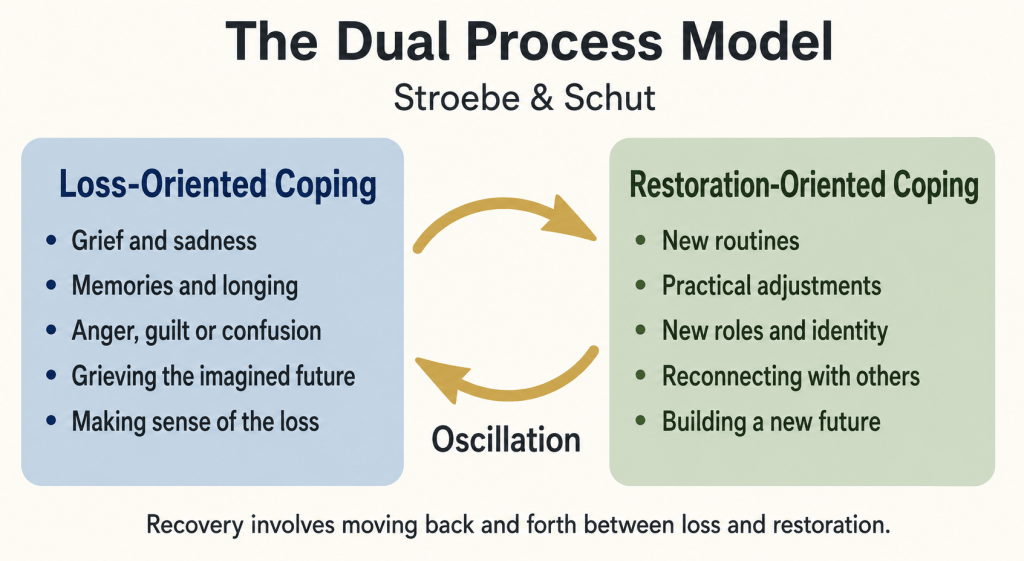
The “Dual Process Model of Coping with Bereavement” was developed by psychologists Margaret Stroebe and Henk Schut to explain how people cope with grief.
The model was originally developed in relation to bereavement after someone dies. However, it can also provide a useful perspective on other significant losses, including the end of an important relationship.
According to the model, people move back and forth between two different ways of coping:
- Loss-oriented coping
- Restoration-oriented coping
This movement is called oscillation. It explains why recovery does not follow a fixed or straight path.
Loss-Oriented Coping
During loss-oriented coping, your attention is focused on what you have lost.
After a relationship ends, this may include:
- missing the other person;
- thinking about memories;
- feeling sadness, anger, guilt, or confusion;
- grieving the future you imagined;
- trying to understand what happened;
- wishing that things had ended differently;
- thinking about what you could have done differently.
These feelings are part of processing the loss. However, you do not need to focus on them constantly in order to heal.
Restoration-Oriented Coping
During restoration-oriented coping, your attention shifts towards rebuilding your daily life.
This may include:
- arranging housing and finances;
- developing new routines;
- creating clearer boundaries;
- adjusting to co-parenting;
- reconnecting with friends and family;
- making decisions independently;
- rediscovering your identity outside the relationship;
- returning to work, hobbies, or personal goals;
- imagining a different future.
Restoration-oriented coping does not mean that you have forgotten the relationship or that it never mattered. It means that you are gradually learning to live with what happened while creating a life that is no longer centred around the relationship.
Moving Between Grief and Recovery
One day, you may feel overwhelmed by memories. The next day, you may enjoy making plans or feel hopeful about the future. Later, a message, anniversary, song, or familiar place may bring the sadness back again.
This does not mean that your recovery has failed.
Healing involves moving between grieving what you lost and building what comes next. You also need moments of distraction, rest, pleasure, and personal growth.
Feeling better for a while does not mean that the relationship did not matter. Feeling sad again does not mean that you are back where you started.
Emotional Patterns Do Not Disappear Overnight
During a relationship, you develop emotional habits. In an unhealthy relationship, you may have learned to monitor the other person’s mood, prevent conflict, explain yourself repeatedly, or put your own needs aside.
These patterns can continue after the relationship has ended.
You may still:
- carefully consider how your former partner might react;
- feel responsible for their emotions;
- experience anxiety when your phone rings;
- feel guilty when you say no;
- question whether your memories are accurate;
- feel the need to explain or defend your decisions;
- change your plans to prevent anger, disappointment, or conflict.
Your relationship status may have changed, while your body and mind are still responding according to the old pattern.
Recognising this does not mean that you are weak. Emotional habits need time, safety, and repeated new experiences before they begin to change.
Guilt Can Keep You Emotionally Connected
Guilt is one of the strongest emotions that can remain after a relationship ends.
You may feel guilty because you left, because the other person is hurt, or because your family situation has changed. If you have children together, you may wonder whether you should have tried harder or stayed longer.
You may also have been made to feel responsible for the other person’s happiness during the relationship. As a result, choosing yourself can initially feel selfish—even when it is necessary.
It is important to remember:
! Feeling guilty does not automatically mean that you have done something wrong !
Sometimes, guilt appears because you are making an unfamiliar choice. Setting a boundary may feel wrong when you have spent years crossing your own boundaries to keep someone else happy.
Co-Parenting Can Make Separation More Complicated
When you share children, the relationship changes but does not disappear completely. You are no longer partners, but you remain connected as parents.
This can be emotionally challenging. You may need to cooperate with someone who has hurt you, while also trying to protect your child from adult conflict.
Healthy co-parenting requires both parents to place the child’s needs above their personal disagreements. Unfortunately, that is not always possible.
When direct cooperation repeatedly leads to tension, more structured or limited communication may be necessary. Clear agreements, predictable routines, and keeping conversations focused on the child can help reduce conflict.
The goal is not to create a perfect relationship between former partners. The goal is to create as much stability and emotional safety for the child as possible.
The Relationship May Continue Inside Your Mind
Sometimes, the strongest remaining connection is no longer the contact itself, but the conversation that continues inside your mind.
You may replay past arguments, imagine what you should have said, or wonder whether the other person finally understands what they did. You may still hope for an apology, recognition, or explanation that makes everything feel complete.
Unfortunately, closure does not always come from the person who caused the confusion or pain.
Sometimes, closure begins when you stop waiting for the other person to confirm your experience.
You are allowed to take your own feelings seriously, even if the other person continues to deny, minimise, or interpret the past differently.
How Can You Begin to Emotionally Let Go?
Emotionally letting go does not mean erasing the past or pretending the relationship never mattered. It means gradually reducing the influence it has over your present life.
You can begin by:
- recognising which situations trigger strong emotions;
- limiting unnecessary contact;
- allowing yourself to grieve both the person and the imagined future;
- writing down agreements and important events;
- talking to someone you trust;
- practising boundaries without repeatedly explaining them;
- creating routines that belong to your own life;
- reconnecting with interests and relationships that became less important;
- making small decisions without seeking the other person’s approval;
- seeking professional support when fear, guilt, confusion, or traumatic stress continues to control your daily life.
Recovery is often found in small moments: the first time you do not respond immediately, the first decision you make without wondering what the other person will think, or the first day when a message no longer determines your mood.
Signs That You Are Moving Forward

You may notice progress when:
- you no longer feel responsible for your former partner’s emotions;
- you can receive a message without immediately feeling afraid;
- you stop explaining every decision;
- you trust your own memories and feelings more;
- you can remember the relationship without losing yourself in it;
- you allow yourself to experience both grief and enjoyment;
- you make choices based on your own values;
- you begin to imagine a future that is no longer connected to the other person;
- your life starts to feel like your own again.
Leaving is sometimes one decision. Emotionally separating can be a much longer process.
Checklist: Is the PAST Relationship Still Influencing Me?
☐ A message from my former partner can affect my mood for hours or days.
☐ I still feel responsible for my former partner’s feelings.
☐ I feel guilty when I set a boundary or say no.
☐ I repeatedly replay conversations and conflicts in my mind.
☐ I continue to question my own memories or judgement.
☐ I make decisions based on how my former partner might react.
☐ I feel the need to explain or defend myself repeatedly.
☐ I am still waiting for an apology, explanation, or recognition before I can move forward.
☐ Practical contact often becomes emotional or conflictual.
☐ I struggle to imagine a future that is completely my own.
Recognising several of these signs does not mean that you have failed to move on. It may simply show which parts of the relationship still need attention, support, or stronger boundaries.
There is no shame in needing time to untangle yourself from a relationship that shaped your thoughts, habits, identity, and expectations.
“The relationship may have ended on a particular day. Reclaiming yourself happens one choice, one boundary, and one step at a time.“


Geef een reactie