What happens before behaviour develops into conflict or aggression and which warning signs do we often overlook?
When a young person shouts, threatens someone or becomes physically aggressive, the problem is visible. But escalation usually begins much earlier.
Changes may already be noticeable in their level of tension, communication, attitude, attendance or interactions with others. Yet too often, our attention turns to the young person only once their behaviour has clearly crossed a boundary.
! Important information may be found in what happened before that point.
Young people who repeatedly become involved in conflict, challenge boundaries or behave aggressively can quickly acquire labels such as ‘problematic’, ‘difficult’ or ‘unmanageable’. Eventually, they may be moved to another class, programme or school. In some situations, this may be necessary to protect safety or maintain the learning environment. However, when we change only the environment without examining what may be underlying the behaviour, we risk relocating the problem rather than addressing it.
Challenging behaviour does not occur without context. A range of factors may contribute to what we see: stress, difficulties with emotion regulation, experiences at home, peer pressure, a need for status or belonging, distrust of adults, frustration, overstimulation, previous negative experiences or feeling unseen or misunderstood.
None of this excuses aggressive or unacceptable behaviour.
! Understanding why behaviour occurs is not the same as accepting it.
In fact, the better we understand what may trigger, maintain or intensify behaviour, the earlier and more effectively we may be able to intervene.
The question therefore becomes:
‘What happened before this behaviour and which signals might we have missed?’

During my Master’s research in Applied Psychology, I investigated physically aggressive student behaviour in vocational education and teachers’ perceived self-efficacy in responding professionally and de-escalating potentially aggressive situations.
Interviews with professionals highlighted the importance of understanding young people’s wider lives, the relationship between student and teacher, peer pressure, emotion regulation, clear boundaries and the early recognition of rising tension. Understanding a student’s background and circumstances can help professionals interpret behaviour more accurately and respond more appropriately.
Prevention therefore does not begin with the threat, the physical incident or the outburst.
! It begins in the moments before it.
An early warning sign does not mean that a young person will become aggressive. What matters particularly is a change from that young person’s usual behaviour. This might include becoming more irritable, withdrawing from others, communicating more confrontationally, responding differently to correction, showing reduced concentration or engagement, being absent more frequently, reacting strongly to perceived loss of face or becoming more concerned with establishing status within a peer group. A single sign tells us very little. A young person who looks angry or misses a lesson is not automatically at risk of becoming aggressive.
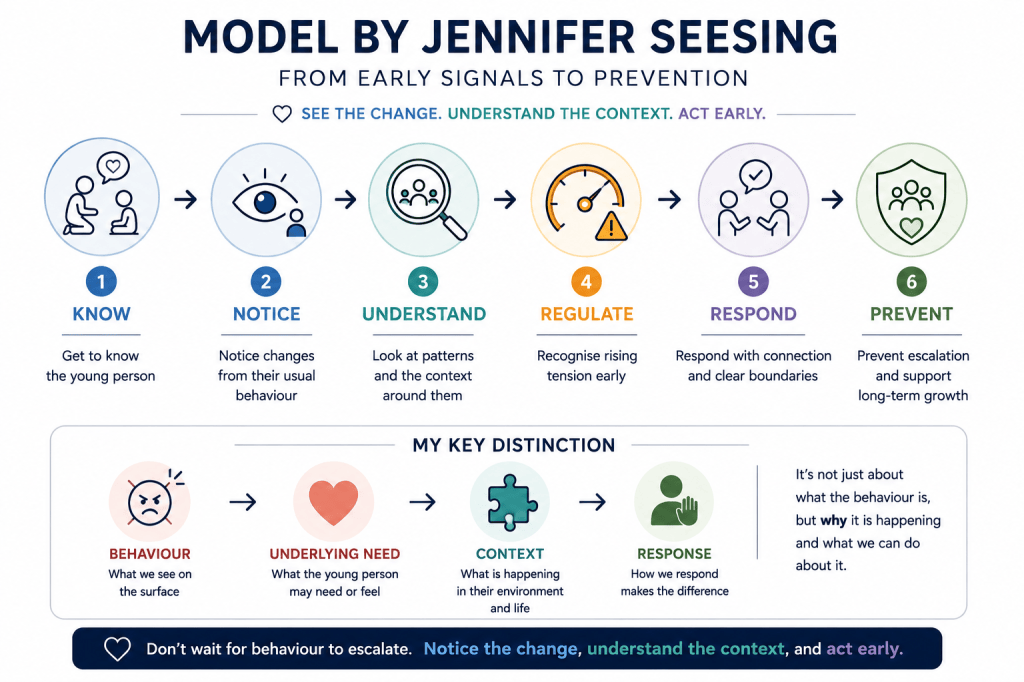
1. Look at rising tension before focusing on the rule being broken
When a young person refuses an instruction, walks away or responds disrespectfully, it is easy to focus first on the rule that has been broken. But doing so can mean overlooking the fact that tension may have been building for some time. This is where emotion regulation becomes relevant. Psychologist James Gross’s process model of emotion regulation describes how people influence which emotions they experience, when they experience them and how those emotions are experienced and expressed.
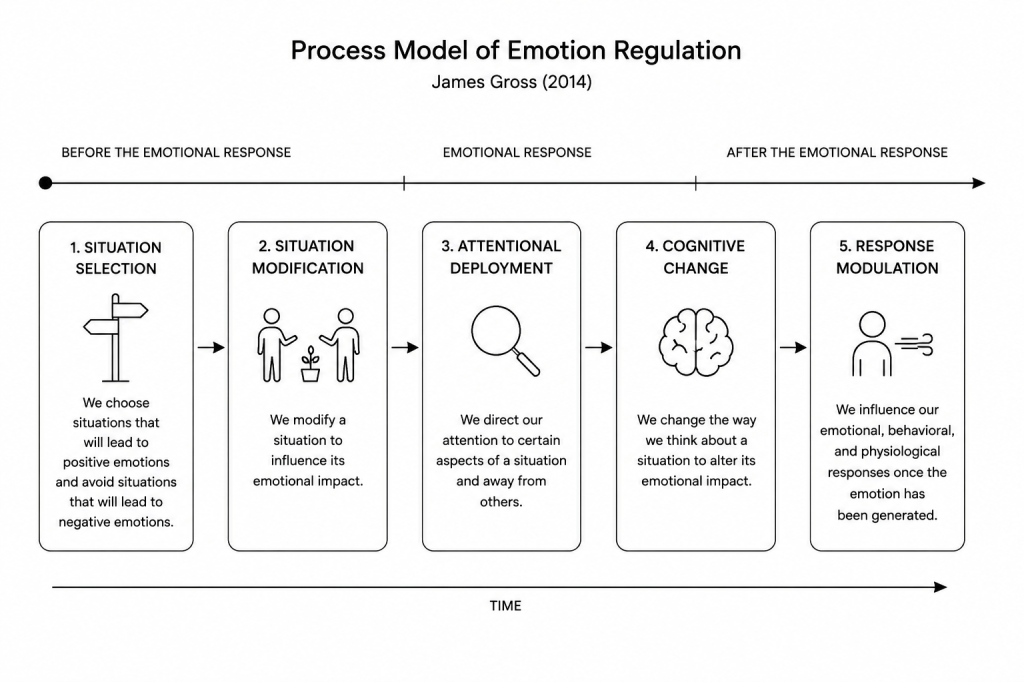
Emotion regulation is not only relevant to the young person. My literature review also indicated that difficulties with emotion regulation among professionals, particularly under pressure, may contribute to more impulsive responses and an increased risk of further escalation.
! A tense young person interacting with a tense adult creates a different dynamic from a tense young person interacting with a professional who is able to recognise and regulate their own emotional response.
2. Pay attention to communication and peer dynamics
Professionals interviewed as part of my research described behaviours including challenging language and attitudes, verbal comments, displays of toughness and the influence of peer pressure. This does not mean that direct language or a particular attitude should automatically be interpreted as aggression.
Again, look for change. Are responses becoming increasingly brief or hostile? Is there less opportunity for dialogue? Is the young person trying to prove themselves in front of others?
The presence of peers can intensify behaviour. A correction that might be accepted in a one-to-one conversation may be experienced very differently when it takes place in front of a group, particularly if the young person experiences it as a loss of face. Students who participated in my research also identified public correction, rapid or punitive responses without first listening, emotional reactions from teachers and inconsistent rules as factors that could intensify conflict. In contrast, remaining calm, listening and demonstrating understanding were identified as responses that could help prevent further escalation.
! Setting a clear boundary does not require publicly confronting or humiliating a young person.
3. Withdrawal can also be a warning sign
Escalation does not always become louder. Sometimes a young person begins to withdraw, becomes less engaged, attends less frequently or stops communicating as openly as before. An attendance coordinator interviewed in my research emphasised the importance of making early contact following absence. This can provide an opportunity to understand what may be happening in a student’s life and identify difficulties at an earlier stage. Absence or withdrawal is not, by itself, problematic behaviour.
! But a noticeable change can be a reason to make contact.
4. Know the young person behind the behaviour
One of the recurring themes in my interviews was the relationship between the young person and the professional. Personal involvement, respect and calm, consistent boundary-setting were identified as factors that may help prevent minor incidents from developing into more serious situations. Other professionals also highlighted the importance of the teacher-student relationship and trust when managing tense situations.Relationships are also essential to early recognition. You can only recognise that someone is behaving differently from usual when you have some understanding of what is usual for that individual.
Early recognition therefore does not begin with a checklist of warning signs.
! It begins with knowing the young person in front of you.
5. Understanding and boundaries can coexist
Trying to understand behaviour does not mean allowing everything. Professionals in my research emphasised the combination of respectful relationships and clear, consistent boundaries. Recognising rising tension, communicating calmly and maintaining boundaries can all happen at the same time.
For example:
‘I can see that you are angry, and I want to hear what happened. But threatening someone is not acceptable. We can have this conversation when we can do so safely.’
! You can acknowledge the emotion without accepting the behaviour.
6. Consider the professional’s response as well
When a situation escalates, we naturally focus on the behaviour of the young person.
But an interaction has two sides.
My research revealed a notable difference. Teachers generally felt relatively confident in their everyday preventive and pedagogical practice, including building relationships, setting boundaries, providing structure and managing tension.
The interviews suggested that young people can notice this tension and that an angry, tense or impulsive response from an adult can contribute to further escalation.
! Effective de-escalation therefore requires not only an understanding of the young person’s behaviour and emotions, but also awareness of the professional’s own emotional response.
The question here is:
‘What is happening in the interaction between this young person and me?’
From ‘problem behaviour’ to pattern recognition
Before escalation occurs, professionals can ask themselves several questions:
- What has changed in the young person’s behaviour, communication, attendance or engagement?
- What happened immediately before the tension increased?
- What role are peers playing?
- How does the young person respond to correction or boundaries?
- What do we know about what may be happening beyond this particular moment?
- How am I responding?
- Is this an isolated incident, or are we seeing a recurring pattern?
This shifts the focus from responding to aggression to recognising and understanding escalation.
Recognition alone is not enough
A professional may recognise rising tension accurately and still not know how to respond. This is consistent with findings from my research: teachers felt less confident when dealing with acute aggressive incidents than they did in everyday preventive and pedagogical situations. Professionals interviewed in the study identified a need for practical training in de-escalation, communication, boundary-setting and safe professional responses. Role-play, peer reflection, clear protocols and support from colleagues were also identified as important. An external trainer further emphasised that one-off training is not enough. Continued practice, reflection, coaching and a shared approach within the professional team are important.
! Early recognition only becomes truly valuable when professionals also know how to respond to what they have recognised.
So, What happens before behaviour develops into conflict or aggression, and which warning signs do we often overlook?
There is no universal checklist that can predict whether a young person will become aggressive. However, before escalation occurs, changes may become visible in tension, communication, attitude, engagement, attendance, social interactions and responses to boundaries.
The danger is that early signs are interpreted only as rude, unmotivated, difficult or unmanageable behaviour. When that happens, we may see the behaviour while overlooking what lies beneath it. Removing a young person from a situation or moving them to a different environment may sometimes be necessary. But if no one explores why the same behaviour continues to occur, there is a risk that we relocate the problem rather than address it.
We need to recognise rising tension earlier, explore what may be driving the behaviour and know how to respond before tension develops into conflict or aggression.
Because if we only start looking when a young person escalates, we may already have started looking too late.


Geef een reactie