Children do not learn only from what their parents tell them. They also observe how their parents treat each other. How do their parents communicate? How do they respond when they are angry? Can they reconnect after an argument?
The relationship between parents therefore provides an important example for a child. This applies both to parents who are together and to separated parents who continue to share responsibility for their child.
Davies and Cummings (1994) proposed the emotional security hypothesis, which later became an important foundation of Emotional Security Theory. In simple terms, children pick up on whether their family environment feels safe and stable. Repeated, intense, and unresolved conflict can undermine that sense of security.
As a result, children may become anxious or highly alert. They may withdraw, but they may also try to stop the argument or protect one of their parents.
Not All Conflict Is the Same
A disagreement between parents is not automatically harmful. Conflict is a normal part of relationships. What matters most is:
- how often conflicts occur;
- how intense they are;
- how parents treat each other during conflict;
- whether the child is drawn into the disagreement;
- whether the parents resolve the conflict afterward;
- whether a sense of safety and calm is restored.
A major scientific review by Harold and Sellers (2018) found that conflict between parents is associated with emotional and behavioral difficulties in children. Shouting, threats, humiliation, aggression, ongoing hostility, and involving a child in the conflict are particularly concerning.
Rhoades (2008) reviewed numerous studies examining how children respond to conflict between their parents. Children appear to be at greater risk when they:
- fear that something serious is going to happen;
- blame themselves for the argument;
- believe they must resolve the conflict;
- feel responsible for one of their parents;
- feel that they have to choose sides.
These feelings may be associated with anxiety, withdrawal, anger, or defiant behavior. This does not mean that every child will develop these difficulties. The research shows associations, and some children are more vulnerable than others.
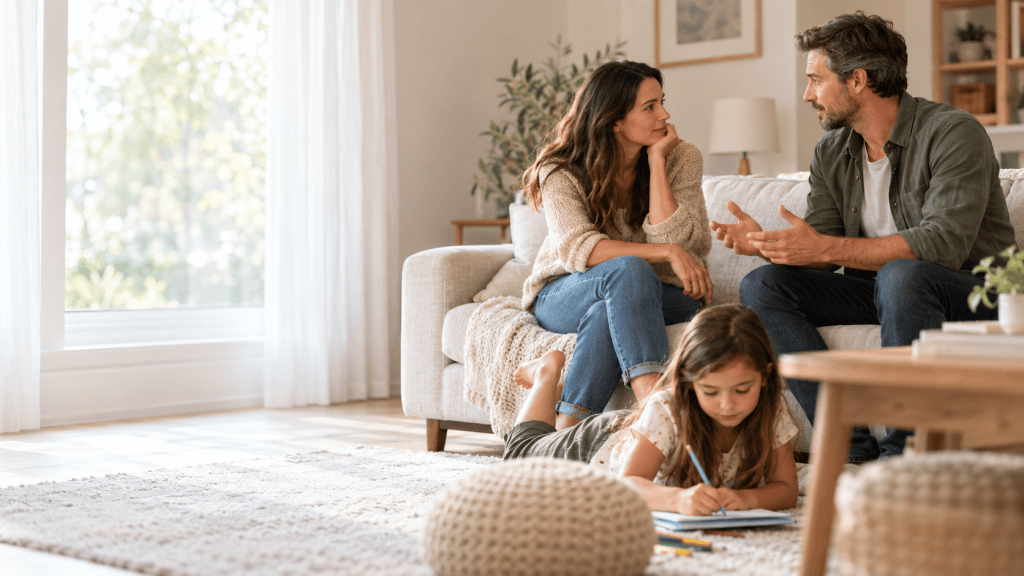
What Different Patterns May Mean to a Child
The inner messages below are examples. Not every child will literally think these things, and children may respond in different ways.
| The child’s experience | Possible message the child may learn | Possible response |
| Respect and predictability | “I am safe, and adults can solve problems.” | Trust and openness |
| An argument followed by repair | “People can argue and make things right afterward.” | Healthier ways of dealing with differences |
| Repeated anger and hostility | “Something could go wrong at any moment.” | Anxiety and hypervigilance |
| Being drawn into the conflict | “I must fix this or choose a side.” | Guilt and loyalty conflicts |
| Having to care for a parent | “My parent’s feelings are my responsibility.” | Suppressing personal feelings and needs |
| Calm and reliable care after separation | “My family is changing, but I am still loved and cared for.” | Sadness alongside gradual adjustment |
Children Do Not Need Perfect Parents
Children do not need parents who never become angry, never make mistakes, and always agree. What they need most are parents who take responsibility for their behavior.
Scientific research distinguishes between destructive and constructive conflict.
Destructive conflict may include:
- shouting;
- threatening;
- humiliation;
- physical aggression;
- manipulation;
- prolonged silent treatment;
- repeatedly having the same unresolved argument;
- asking the child to choose sides;
- allowing conflict to continue without repair.
Constructive conflict looks different. Parents may disagree, but they remain respectful. They listen to each other, take time to calm down when necessary, look for a solution, and reconnect afterward.
A child can then learn that people can:
- have different opinions;
- listen to each other;
- take time to calm down before continuing a conversation;
- set boundaries;
- take responsibility;
- apologize;
- find compromises;
- reconnect after conflict.
Goeke-Morey, Cummings, and Papp (2007) studied how children respond to different ways in which parental conflicts end. Children appeared to be sensitive to whether a disagreement had truly been resolved. A solution, compromise, or reconciliation helped restore their sense of security. An unresolved argument, however, could allow the tension to continue.
It is therefore important that a child not only witnesses the argument but, whenever possible, also sees or hears that the situation has been resolved.
A parent might say:
“You may have noticed that we were angry with each other. That was not your fault, and you do not have to fix it. We have now talked about it calmly.”
The child does not need to know all the details. A short and reassuring explanation is usually enough.
Why Some Children Become Highly Alert
Children need to feel safe. If there is frequent tension at home, they may constantly try to predict what is going to happen next.
A child may:
- constantly monitor their parents’ moods;
- become frightened when voices are raised;
- try to prevent arguments;
- protect one parent;
- become unusually quiet and compliant;
- withdraw;
- become angry or defiant;
- have difficulty sleeping;
- experience stomachaches or headaches;
- suppress their feelings and needs.
This does not automatically mean that the child is difficult or overly sensitive. Their behavior may be an attempt to cope with tension and uncertainty.
Rhoades’ (2008) meta-analysis found that children’s feelings, thoughts, and behavior during parental conflict are associated with their emotional and behavioral adjustment.
However, caution is important. Stomachaches, sleep problems, anxiety, or challenging behavior can also have other causes. A single sign does not prove that parental conflict is the cause.
A Child Should Not Have to Become the Mediator
When a child is drawn into a conflict between parents, psychologists call this triangulation.
This may happen when a parent:
- uses the child to pass messages to the other parent;
- asks the child who is right;
- speaks negatively about the other parent;
- expects the child to keep secrets;
- relies on the child for emotional support;
- reacts with disappointment when the child has enjoyed spending time with the other parent;
- expects the child to help resolve the conflict.
McCauley, Sloan, Xia, and Fosco (2021) found that triangulation may be associated with children becoming increasingly focused on conflict between their parents. At the same time, parents may not fully realize how much stress their child is experiencing.
The child may begin to feel responsible for keeping the peace in the family. They may also believe that loving one parent means betraying the other.
A protective message is:
“This is a problem between adults. You do not have to solve it, you do not have to choose a side, and you are allowed to love both of us.”
When a Child Begins to Care for a Parent
Sometimes the roles of parent and child become reversed, and the child begins to care for the parent. In psychology, this is known as parentification.
This can involve practical responsibilities, but it can also involve emotional caregiving. For example, a child may repeatedly try to reassure a parent, feel responsible for the parent’s happiness, or listen to problems that are too heavy for their age.
Not every form of helping is unhealthy. It is normal for a child to help at home or give a sad parent a hug. It becomes more concerning when:
- the child is given an adult role for a prolonged period;
- the responsibility is not appropriate for the child’s age;
- the child feels responsible for the parent’s well-being;
- there is little room for the child’s own feelings and needs;
- the child receives too little support or recognition.
Dariotis and colleagues (2023) reviewed 95 studies on parentification. The outcomes varied. Some children developed independence or strong coping skills. At the same time, parentification was also associated with emotional difficulties, behavioral problems, and physical health concerns. The demands placed on the child, the child’s age, the support available, and the recognition the child receives can all affect the outcome.
It would therefore be too simplistic to say that every child who cares for a parent will automatically be harmed. The risk becomes greater when a child carries responsibilities that belong to an adult for a long period of time.
Parents Show Children How to Handle Emotions
Children learn how to deal with anger, sadness, fear, and disappointment by observing their parents.
They notice:
- how their parents express emotions;
- how their parents respond to the child’s emotions;
- whether feelings can be discussed at home;
- whether their parents can calm themselves down;
- whether their parents take responsibility for hurtful behavior.
Holzman, Kennedy, Grassie, and Ehrenreich-May (2022) found an association between parents’ emotion regulation and mental health symptoms in children and adolescents. Parenting behavior may be one of the pathways through which this relationship develops.
Healthy emotion regulation does not mean that a parent must always remain calm. It means that the parent takes responsibility for what they do with their emotions.
For example, a parent might say:
“I can feel myself becoming angry. I am going to take a moment to calm down so I do not say something hurtful.”
“We disagree, but we can still treat each other with respect.”
“I raised my voice. That was not okay, and I am sorry.”
“My feelings are not your responsibility.”
Responding to a Child with Attention and Sensitivity
When a parent notices a child’s signals and responds to them, the child learns that their feelings matter and that support is available.
The Center on the Developing Child at Harvard University calls this serve and return. The child gives a signal, and the adult responds. For example, a baby makes a sound and the parent responds, or a child looks upset and the parent asks what is wrong.
These simple back-and-forth interactions support the development of language, social skills, and emotion regulation (Center on the Developing Child at Harvard University, n.d.-a).
What Can a Child Learn from a Healthy Parental Relationship?
A healthy relationship between parents or separated co-parents can teach a child that:
- love goes together with safety and respect;
- both people are allowed to have needs;
- setting a boundary is not the same as rejecting someone;
- love does not depend on perfect behavior;
- disagreements can be discussed without fear;
- no one should have to make themselves smaller;
- people are responsible for their own behavior;
- apologies should be followed by changes in behavior;
- trust grows when people are reliable;
- independence and connection can exist together;
- love allows people to remain themselves.
A healthy relationship does not mean that there is never any tension. It means that tension does not repeatedly come at the expense of safety, respect, and equality.
What Can a Child Learn from an Unhealthy Relationship?
When a child is exposed to unhealthy patterns for a long time, they may develop beliefs such as:
- “Love means I have to change myself.”
- “Jealousy is proof of love.”
- “Controlling behavior means someone wants to protect me.”
- “Keeping the peace is more important than my own needs.”
- “Saying no leads to anger or rejection.”
- “The other person’s feelings are more important than mine.”
- “I am responsible for other people’s happiness.”
- “Hurtful behavior is a normal part of relationships.”
- “An apology is enough, even when the behavior does not change.”
- “Love is supposed to feel uncertain or frightening.”
These are possible lessons. They do not mean that every child will develop these beliefs or repeat the same patterns later in life. Children can have new experiences and learn from healthier examples of love and safety.
What Happens After Separation or Divorce?
A separation or divorce is usually a major change for a child. It can lead to sadness, anger, and uncertainty. However, the separation itself does not fully determine how the child will develop.
The following factors also matter:
- how much conflict continues between the parents;
- whether the child is drawn into that conflict;
- whether the child has access to emotionally available and trustworthy caregivers;
- whether arrangements are clear and predictable;
- whether the child can maintain safe and supportive relationships;
- whether daily life provides calm and structure.
Van Dijk, Van der Valk, Deković, and Branje (2020) reviewed 115 samples involving a total of 24,854 divorced families. They found small but consistent associations between post-divorce conflict, parenting behavior, and emotional and behavioral difficulties in children.
Hostile parenting, a lack of structure, intrusive parenting, and unclear boundaries between the roles of parent and child were among the family processes associated with children’s adjustment.
Stability after separation does not therefore mean that parents must remain together. It mainly means that the child receives reliable care, is protected from the conflict, and, where it is safe and appropriate, is free to maintain a loving relationship with both parents.
A parent might say:
“Our family looks different now, but you are still loved. The separation is not your fault, and you do not have to take care of us.”
Risk Does Not Mean That an Outcome Is Certain
The studies show associations. They do not prove that every child who experiences parental conflict or separation will later develop emotional or relationship difficulties.
A child’s development is influenced by many different factors, including:
- the child’s personality and age;
- how severe and long-lasting the conflict is;
- the child’s relationships with parents and other caregivers;
- support from relatives, school, and other adults;
- calm and predictability in everyday life;
- opportunities to talk about feelings;
- the presence of at least one reliable adult.
According to the Center on the Developing Child at Harvard University, a safe and supportive relationship with a caring adult can help buffer a child’s stress response. Such a relationship supports the child’s resilience and healthy development (Center on the Developing Child at Harvard University, n.d.-b).
Repair within the family can also make an important difference. Parents can provide new and safer experiences by:
- acknowledging that certain behavior was wrong;
- making it clear that the child is not to blame;
- listening without immediately becoming defensive;
- keeping adult problems with the adults;
- following through on arrangements as reliably as possible;
- seeking help when patterns are difficult to change;
- making sure apologies are followed by different behavior.
Children do not need perfect parents. They mainly need parents who take responsibility, maintain healthy boundaries, and try to restore safety after mistakes.
The most important message a child can receive is:
“You are the child. You do not have to carry our problems. You are allowed to feel whatever you feel, and you will always be loved.”
References
Center on the Developing Child at Harvard University. (n.d.-a). Serve and return.
Center on the Developing Child at Harvard University. (n.d.-b). Toxic stress.
Dariotis, J. K., Chen, F. R., Park, Y. R., Nowak, M. K., French, K. M., & Codamon, A. M. (2023). Parentification vulnerability, reactivity, resilience, and thriving: A mixed methods systematic literature review. International Journal of Environmental Research and Public Health, 20(13), 6197.
Davies, P. T., & Cummings, E. M. (1994). Marital conflict and child adjustment: An emotional security hypothesis. Psychological Bulletin, 116(3), 387–411.
Goeke-Morey, M. C., Cummings, E. M., & Papp, L. M. (2007). Children and marital conflict resolution: Implications for emotional security and adjustment. Journal of Family Psychology, 21(4), 744–753.
Harold, G. T., & Sellers, R. (2018). Annual research review: Interparental conflict and youth psychopathology: An evidence review and practice-focused update. Journal of Child Psychology and Psychiatry, 59(4), 374–402.
Holzman, J. B. W., Kennedy, S. M., Grassie, H. L., & Ehrenreich-May, J. (2022). Associations between dispositional parental emotion regulation and youth mental health symptoms: A systematic review and meta-analysis. Clinical Psychology Review, 95, 102174.
McCauley, D. M., Sloan, C. J., Xia, M., & Fosco, G. M. (2021). Same family, divergent realities: How triangulation preserves parents’ illusory harmony while adolescents navigate interparental conflicts. Journal of Family Psychology, 35(2), 128–137.
Rhoades, K. A. (2008). Children’s responses to interparental conflict: A meta-analysis of their associations with child adjustment. Child Development, 79(6), 1942–1956.
Van Dijk, R., Van der Valk, I. E., Deković, M., & Branje, S. (2020). A meta-analysis on interparental conflict, parenting, and child adjustment in divorced families: Examining mediation using meta-analytic structural equation models. Clinical Psychology Review, 79, 101861.


Geef een reactie