How to Navigate Conflict in Your Relationship and Rebuild Trust When Things Go Wrong
J. Seesing, MSc
11-10-2026
We all argue. Some of us more often than others.
Even in healthy relationships, disagreements are inevitable. Sometimes an argument begins with something small: a comment taken the wrong way or a simple misunderstanding.

One person wants to talk things through immediately, while the other withdraws. Before you know it, the argument is no longer about the original issue. Instead, you feel unheard or misunderstood.
Past experiences can also influence how we respond during conflict. Perhaps you learned early in life that you had to fight to be heard. Or perhaps you learned that withdrawing was the safest option. Without realising it, you may find yourself falling back into familiar patterns.
As a result, two people can unintentionally hurt each other while both are simply trying to cope with the situation.
How Do You Handle Conflict?
Think back to a recent disagreement with your partner. Rate yourself on each of the following statements using a scale from 1 to 5.
1 = Almost never · 2 = Rarely · 3 = Sometimes · 4 = Often · 5 = Almost always
| Statement | Your rating |
| 1. I recognise my emotions and can express how I feel. | ① ② ③ ④ ⑤ |
| 2. When I need some space, I explain when we can continue the conversation. | ① ② ③ ④ ⑤ |
| 3. I listen without immediately judging or becoming defensive. | ① ② ③ ④ ⑤ |
| 4. I can acknowledge my own contribution to an argument. | ① ② ③ ④ ⑤ |
| 5. After an argument, I make an effort to reconnect. | ① ② ③ ④ ⑤ |
(Keep your scores in mind. Later in this article, you will discover what they may reveal about the way you handle conflict.)
For a long time, I believed that an argument could only be resolved once everything had been discussed. But what if the other person needs some space at that moment? I learned that taking a step back is not the same as breaking the emotional connection. At the same time, I discovered something important about my own needs: clarity.
How do I respond when emotions run high? And what do I need in those moments?
I do not always need an immediate solution. What matters to me is knowing that we are willing to work through the problem together.
Sometimes, one simple sentence is enough:
“We’ll work through this together.”
That insight inspired me to develop the STAY Model…
The STAY Model
Staying Connected Through Conflict
STAY consists of four practical steps designed to support healthier communication during disagreements.
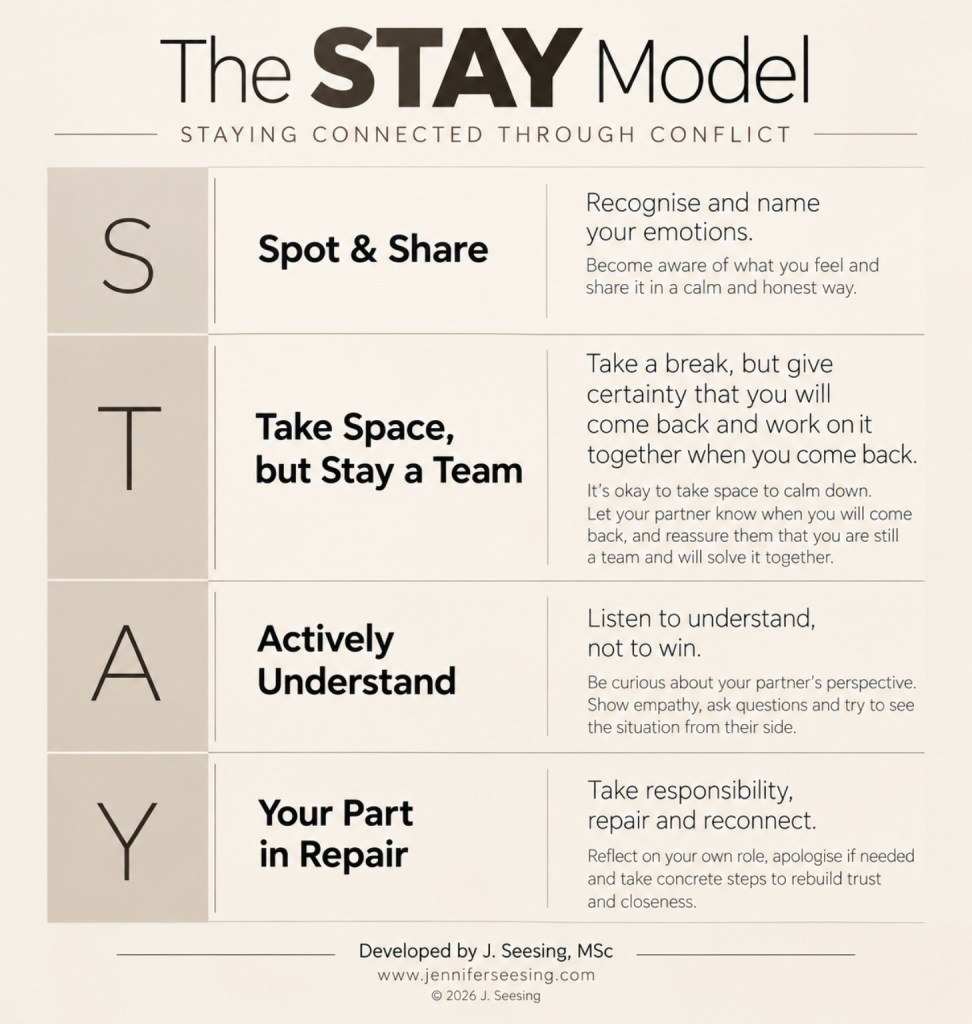
S – Spot & Share
Recognise and express your emotions.
Take a moment to identify what you are feeling. Are you angry, disappointed or hurt?
Express those feelings without immediately blaming the other person.
“I can feel myself getting angry. But underneath that anger, I think I’m actually feeling hurt.”
T – Take Space, but Stay a Team
Take a break, but provide reassurance and clarity.
Taking a break can prevent an argument from escalating. Explain when you will return to the conversation and reassure your partner that you are committed to working things through together.
“I’m too angry to talk calmly right now. I’m going for a half-hour walk. Afterwards, we can continue the conversation. We’ll work through this together.”
A – Actively Understand
Listen to understand, not to judge.
Ask questions before drawing conclusions. You do not have to agree with someone to take their feelings and experiences seriously.
“I see things differently, but I want to understand how you experienced it.”
“What did you need from me in that moment?”
Y – Your Part in Repair
Take responsibility for your part.
Reflect on your own contribution to the conflict. What could you have done differently?
Acknowledge your mistakes and discuss what you could both change.
“I’m sorry I reacted that way. What could we do differently next time?”
The Psychology Behind “STAY”
STAY draws on established psychological concepts. Gross (1998) describes the importance of emotion regulation. Gottman (1999) highlights the role of managing emotional tension and making attempts to repair interactions during conflict. Johnson (2004) explains how partners can become caught in recurring patterns of pursuing connection and withdrawing from it.
These theories provide support for the individual principles underlying STAY.
Back to Your Scores!
What Do Your Scores Tell You?
The five statements you rated earlier correspond to the four components of STAY.
| Component | Question | What your score reflects |
| S — Spot & Share | 1 | How well you recognise and communicate your emotions |
| T — Take Space, but Stay a Team | 2 | How clearly you communicate when you need space |
| A — Actively Understand | 3 | How well you listen without judging |
| Y — Your Part in Repair | 4 and 5 | How you take responsibility and make efforts to reconnect |
Where Are Your Strengths?
A score of 4 or 5 suggests that you often demonstrate this behaviour. A score of 1 or 2 may indicate an area for development. A score of 3 suggests that you sometimes put this behaviour into practice.
For the Y component, consider both scores separately. This can help you identify whether taking responsibility and reconnecting come equally naturally to you.
There are no right or wrong answers. Your scores are intended to help you identify which aspect of STAY may deserve more attention.
(This questionnaire is intended for self-reflection)
Resolving Conflict Is Not the Same as Rebuilding Trust
Sometimes, talking through an argument is not enough.
You may have discussed everything, yet something still feels unresolved. Perhaps hurtful words were exchanged or a promise was broken.The argument may be over, but the trust has not yet been restored. Resolving a conflict is not the same as rebuilding trust.
That is why I developed the REPAIR Model…
The REPAIR Model
Rebuilding Trust & Connection
REPAIR consists of six practical steps to support the process of rebuilding trust and connection after a conflict.
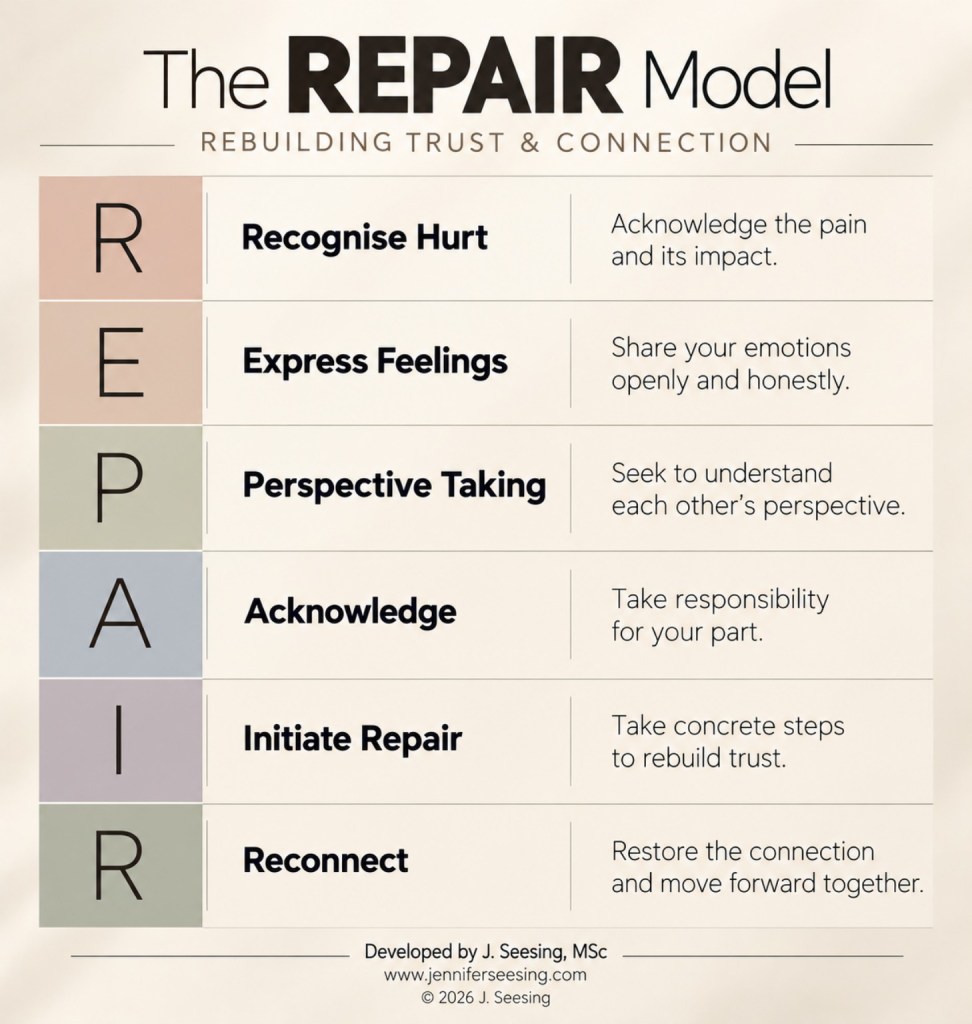
R – Recognise Hurt
Acknowledge the hurt.
Take your partner’s pain seriously, even if causing that pain was never your intention.
“I understand that what I said hurt you.”
E – Express Feelings
Express how the experience affected you.
Give each other the opportunity to share your feelings openly.
“I’d like to explain why this was so difficult for me.”
P – Perspective Taking
Try to understand each other’s perspective.
Ask questions rather than making assumptions.
“What was the hardest part of what happened for you?”
A – Acknowledge
Take responsibility.
Acknowledge your behaviour without immediately trying to justify it.
“I should have responded differently. I’m sorry.”
I – Initiate Repair
Make concrete agreements.
Discuss what needs to change. Then demonstrate through your actions that you are committed to following through.
“What can we agree on to help prevent this from happening again?”
R – Reconnect
Re-establish the connection.
Talk about what you both need to feel comfortable and secure with each other again.
“What do you need from me to begin rebuilding your trust?”
The Psychology Behind REPAIR
Research on the development and maintenance of trust highlights the importance of responsibility and consistent, trustworthy behaviour (Lewicki & Bunker, 1996).
Worthington (2006) distinguishes between forgiveness and reconciliation. Forgiving someone does not automatically mean that trust has been restored.
Johnson (2004) also emphasises the importance of acknowledging emotional experiences and restoring emotional connection.
Together, these insights form the theoretical foundation of REPAIR.
Rebuilding trust can take time. An apology may help, but ultimately, behaviour must change as well.
Repair requires a willingness from both partners. In situations involving violence, intimidation or coercion, personal safety must always take priority.
It Does Not Have to Be Perfect
Not every argument requires a lengthy conversation. And we do not always have the time or emotional energy to work through every step.
Sometimes we react too quickly. Sometimes we say things we later regret. And sometimes we only realise afterwards what the other person needed.
What matters is not that you never make mistakes, but how you respond afterwards.
So ask yourself:
“What do you need right now?”
“And what do I need?”
Perhaps the answer is some space, an honest conversation or a clear agreement.
A healthy relationship does not mean never arguing. It means learning how to navigate differences and taking responsibility when things go wrong.
You do not always have to agree to move forward together.
“We’ll work through this together.”
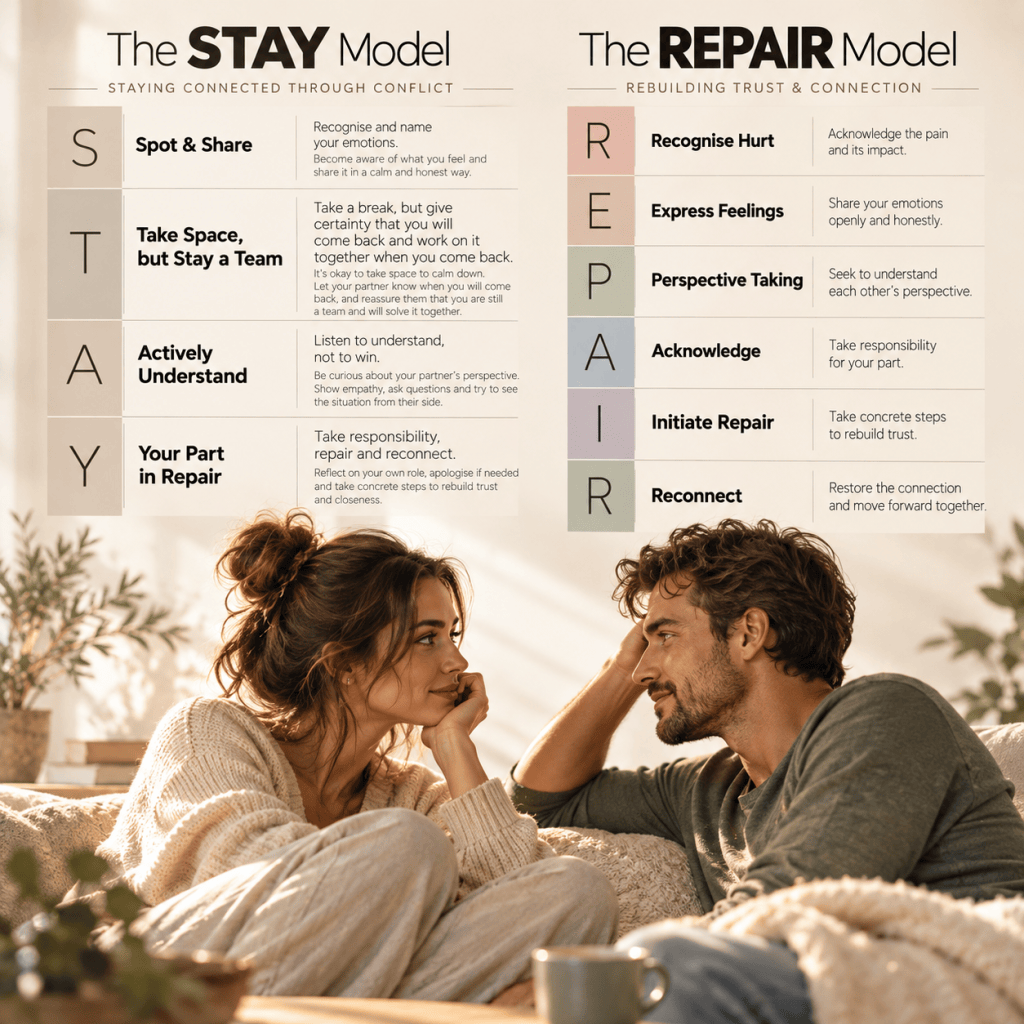
About the Models
The STAY & REPAIR Framework
Developed by J. Seesing, MSc | © 2026
STAY and REPAIR are theoretically informed practical models. They translate established psychological concepts into accessible steps for managing relationship conflict and supporting the restoration of trust and emotional connection.
The models have not yet been independently subjected to scientific validation.
References
Gottman, J. M. (1999). The marriage clinic: A scientifically based marital therapy. W. W. Norton.
Gross, J. J. (1998). The emerging field of emotion regulation: An integrative review. Review of General Psychology, 2(3), 271–299.
Johnson, S. M. (2004). The practice of emotionally focused couple therapy: Creating connection (2nd ed.). Brunner-Routledge.
Lewicki, R. J., & Bunker, B. B. (1996). Developing and maintaining trust in work relationships. In R. M. Kramer & T. R. Tyler (Eds.), Trust in organizations: Frontiers of theory and research (pp. 114–139). Sage.
Worthington, E. L., Jr. (2006). Forgiveness and reconciliation: Theory and application. Routledge.


Geef een reactie